AI, obviousness, and the technical expertise: Is the benchmark for inventive activity changing?
For decades, patent law has operated with a comfortable and relatively stable figure: the "person having ordinary skill in the art," also known as PHOSITA ( Person Having Ordinary Skill In The Art ). This is not a genius, not the inventor, nor someone uninformed. It is the average professional in the field, possessing the knowledge and skills normally expected in that technical area. It is based on this professional that decisions are made as to whether an invention truly involved inventive activity or was merely an obvious consequence of what was already known, thus determining the patentability of a patent application. The problem is that this average professional is changing. And perhaps changing faster than the legal concept used to represent them.
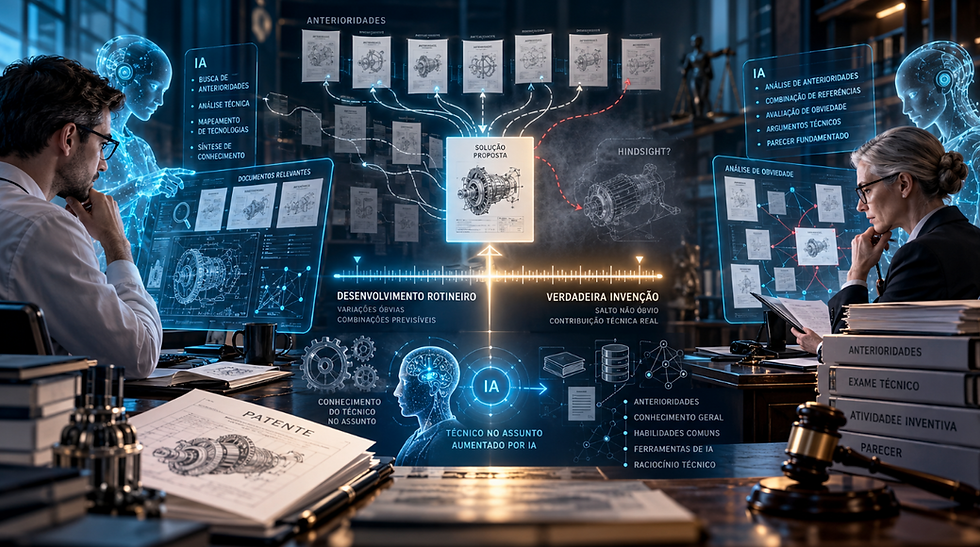
Today, engineers, chemists, biologists, programmers, and researchers already use artificial intelligence tools to search for information, compare solutions, cross-reference data, suggest alternatives, and explore technical paths on a scale that would have been impractical just a few years ago. This leads to an uncomfortable question: if AI becomes integrated into a professional's ordinary work, does it still make sense to evaluate the obvious from the perspective of a hypothetical technician who does not have these tools? It is from this provocation that the idea of the "augmented subject matter expert" arises , not as an already recognized legal category, but as a possible consequence of the transformation of technical practice itself.
The debate becomes even more interesting because AI is not only in the hands of inventors. It is also reaching the hands of those who examine it. In our country, the INPI (National Institute of Industrial Property) has already established its own policy for the use of artificial intelligence and has been developing applications focused on classification, prior art searches, and examination of patent applications.
Other patent offices abroad, such as the US (USPTO) and the European (EPO), are moving in the same direction, incorporating systems capable of locating technically similar documents, organizing large volumes of information, and making prior art searches increasingly thorough. The examiner, in other words, is also being "augmented."
And here arises the most delicate point: an enhanced examiner cannot retroactively transform the subject matter expert into someone who has always had the same capabilities . If a current tool can locate, in seconds, three old documents that, combined, approximate the invention, this does not mean that this combination was evident at the filing date. The risk of hindsight , the ability to retrospectively assess whether an invention was obvious when it was conceived , remains, perhaps even greater. The more powerful the search tool, the easier it is to reconstruct, after knowing the solution, a seemingly logical path to reach it.
At the same time, it would be artificial to ignore that the ordinary level of technical skill itself can change. If certain AI tools become commonplace in a sector, it is plausible that what previously required greater creative effort will become a routine activity. The bar for inventive activity, therefore, can be raised without any alteration to the text of the law. Not because the legislation has become more severe, but because the meaning of "ordinary skill" has ceased to be the same. The decisive point becomes identifying when a technology ceases to be extraordinary and becomes part of the normal repertoire of the average professional.
AI also changes how applications are prepared. Today, it's possible to explore countless variations, combinations, and implementation methods in a short time, producing denser and more extensive descriptions, as well as more refined claims. However, this doesn't mean that a machine can manufacture inventive activity through textual complexity. An application can be sophisticated, extensive, and technically well-written and still claim something obvious. Similarly, a combination suggested by AI doesn't become obvious simply because a model was able to propose it. The law will continue to need to distinguish between a solution that could be obtained through ordinary procedures and one that truly required an inventive step.
Perhaps, therefore, the most important question about artificial intelligence and patents is not whether AI can be an inventor. An even more immediate question is what happens when AI becomes part of what we expect from an inventor, a researcher, and, above all, a technician "with ordinary skills ." The technician of the future will probably remain a legal fiction. But it will hardly remain the same fiction. And, when the ordinary tools of a professional are capable of researching, comparing, and proposing solutions on a superhuman scale, the patent system will have to decide where, ultimately, routine technical development ends and what still deserves to be called an invention begins.
(Human text generated with the aid of AI)


Comments