Copyright and Games: How a Copyright Infringement Astronomically Increased the Value of a Virtual Item
We know that, under Brazilian law, Copyright protects creations of the mind expressed by any means or fixed in any tangible or intangible medium, whether currently known or developed in the future, granting economic and moral rights to the authors of original works, as provided for in Article 7 of the Brazilian Copyright Law (Law No. 9,610/1998):
Article 7. Intellectual works protected under this Law are creations of the mind, expressed by any means or fixed in any tangible or intangible medium, whether currently known or developed in the future, such as: (…)
Likewise, in the United States, all original works of authorship that are fixed are eligible for copyright protection, pursuant to 17 U.S.C. § 102:
(a) Copyright protection subsists, in accordance with this title, in original works of authorship fixed in any tangible medium of expression, now known or later developed, from which they can be perceived, reproduced, or otherwise communicated, either directly or with the aid of a machine or device. Works of authorship include the following categories: (…)
Therefore, an idea alone is not sufficient to enjoy the rights granted by copyright legislation. The idea must be fixed in some form of expression and, in addition, must possess a certain degree of originality.
This means that, regardless of whether a work is considered “good” or “special,” in order to qualify for Copyright protection, it must contain an element of creation. According to João Henrique da Richa Fragoso, “the aesthetic assessment of the work does not matter; what matters is that it is a work and, above all, that it is original.”
Furthermore, originality should not be confused with novelty. In other words, a work may or may not be unprecedented, but it must be original in the way it treats a theme or subject considered common or ordinary.
In Feist Publications v. Rural Telephone Service, 499 U.S. 340 (1991),¹ one of the most well-known leading cases concerning the requirements for determining whether a particular work is protected by Copyright, the U.S. Supreme Court held that the “sweat of the brow”—that is, the effort involved in producing a work—is not sufficient, by itself, for that work to be considered original and copyrightable. There must always be a “creative spark” in order for originality, and consequently Copyright protection, to be established.
In this sense, the main objectives of Copyright are to: (i) encourage creativity for the benefit of society as a whole; (ii) respect authors’ natural rights to the fruits of their work; (iii) protect the personal connection between authors and their works; and (iv) promote public access to works while granting authors a private and limited reward for their creations.
But what exactly are these “creations of the mind, expressed by any means or fixed in any tangible or intangible medium”? In other words, which creations and works are protected by Copyright?
Paintings, drawings, books, films, music, and photographs are among the most common examples of copyright-protected works, particularly because they are part of virtually everyone’s everyday life. After all, who does not enjoy listening to good music on the weekend or watching a good movie on a Sunday?
Today, however, games have gained increasing recognition and are now commonly found in Brazilian households, whether on mobile phones, computers, or even television screens, especially given the growth of eSports championship broadcasts and popular streaming platforms.
So, what is the relationship between games and Copyright?
Games are extremely fertile ground for virtually every area of Intellectual Property, and Copyright is no exception. A game may incorporate elements related to Patents, Industrial Designs, Trademarks, Software, and, especially, thousands of elements protected by Copyright.
From a game’s storyline and characters to its famous cinematic sequences, many elements may qualify as copyright-protected works. However, it is the so-called skins that have been drawing particular attention in the market. The well-known expression “follow the money” helps explain why so much attention is being directed toward these virtual items.
Skins are essentially virtual, intangible products that may be purchased within a game, whether to customize a player’s equipment or to decorate and dress a character, giving each gamer a sense of personality and individuality, much in the same way that clothing and accessories can represent a person’s identity in the “real” world.
Below are some examples of skins traded in the virtual market:

Skins de roupas para diferenciar personagens do Fortnite. Disponível em https://www.elo7.com.br/kit-skins-fortnite-mdf/dp/10CB79D

Skins para ornamentar equipamentos no Counter-Strike GO. Disponível em https://s2.glbimg.com/LJ0WrcX3B0iZkvnP9aY4W4c_dic=/0x0:1500×1500/984×0/smart/filters:strip_icc()/i.s3.glbimg.com/v1/AUTH_bc8228b6673f488aa253bbcb03c80ec5/internal_photos/bs/2021/9/e/Nr4vGeQeiAtMr9cxGZJA/snakebite-case-csgo.jpg
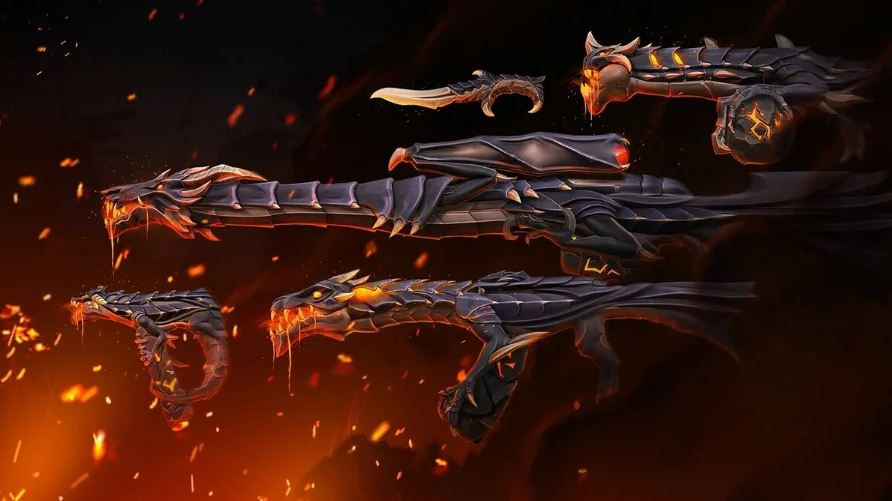
Skins para ornamentar equipamentos no Valorant. Disponível em https://image-cdn.essentiallysports.com/wp-content/uploads/20200712180753/pbs_twimg_com-EcgXUcTWsAAMjEc.jpg?width=900 Neste compasso, pode-se concluir que as artes criadas para ornamentar personagens e equipamentos virtuais, dentro dos games, encaixam perfeitamente na definição de obras protegidas por Direitos Autoriais, visto que são criações do espírito, expressas por meios intangíveis.
Mas os autores dessas obras são recompensados financeiramente pela criação dessas artes?
A resposta é sim! Como toda e qualquer obra original, ao autor cabe os direitos patrimoniais relativos à obra, o que permitirá a sua monetização por meio de contratos de licenciamento ou de cessão de direitos autorais patrimoniais.
No caso das skins, as desenvolvedoras de games pagam uma porcentagem das vendas para cada criador/autor. Por exemplo, em 2019, a Valve, desenvolvedora do Counter-Strike GO, declarou que pagou $45 milhões de dólares para os criadores de skins.
Em 2012, início do hype das skins para jogos, um artista, criador de skins, arrecadava cerca de $40 mil dólares por ano com a monetização das suas criações. Já em 2015, um criador de skins declarou² que recebeu por volta de $200 mil dólares em dois anos a partir da porcentagem paga pela desenvolvedora com a venda de suas skins, desenvolvidas para o jogo Counter-Strike GO.
Em um mercado que não para de crescer, o mercado de games, impulsionado pelo isolamento social, que reduziu a compra de itens físicos, como roupas, sapatos e acessórios, as skins se tornaram produtos virtuais, intangíveis, muito desejados pelos jogadores que tem o desejo de adquirir itens únicos, exclusivos e que são capazes de representar a sua personalidade dentro de um jogo virtual.
Quanto custa uma skin?
Depende. Skins possuem valores completamente variados, podendo custar centavos e chegar na casa dos milhares, literalmente.
Esse foi o caso da conhecida skin para equipamentos do Counter-Strike Go, a “Howl”.
O caso ficou famoso justamente por tratar de uma infração de Direito Autoral, uma vez que a pessoa que se identificou como criador da arte, enviada e validada pela desenvolvedora do game, na realidade estava copiando a obra de outro autor.
Uma vez dentro do mercado virtual do Counter-Strike GO, a skin original da “Howl” foi vendida para um pequeno número de jogadores, até o momento em que a desenvolvedora foi Notificada Extrajudicialmente pelo autor da obra original.
O autor da obra original foi capaz de provar a autoria da obra e fez valer os seus Direitos Autorais, recebendo uma quantia pelo que já tinha sido arrecadado pela desenvolvedora com a vendas das skins que exibiam a obra original e fazendo cessar as vendas futuras de equipamentos com a sua obra.

Obra original criada por CanisAlbus, autor da arte. Disponível em https://cdn.mos.cms.futurecdn.net/sygRHgM8nVF2dqoBNiiBUW-970-80.jpg
Neste compasso, a desenvolvedora modificou e alterou a obra original, com o objetivo de não mais infringir o direito do autor.
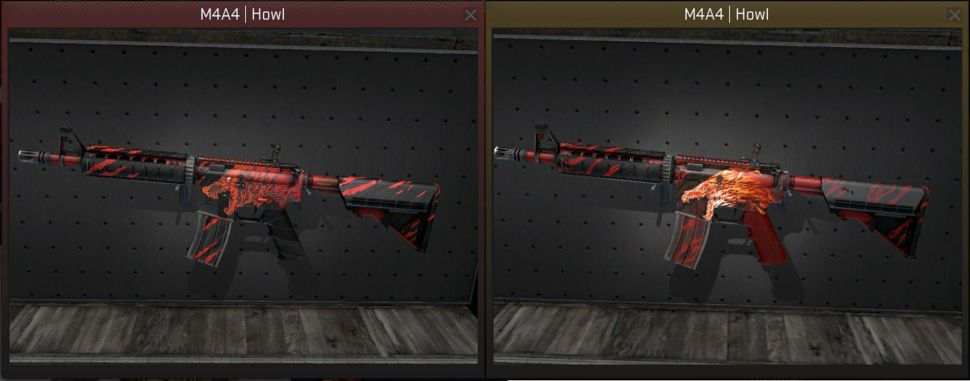
À esquerda, skin Howl original e à direita skin Howl modificada pela desenvolvedora do jogo. Disponível em https://cdn.mos.cms.futurecdn.net/sr4x3L2ZcXmpx3oXTGrmSW-970-80.jpg
Com esse movimento, as novas skins “Howl” foram lançadas no mercado virtual, mas os equipamentos que já haviam sido vendidos para jogadores de Counter-Strike GO com a obra original infringida, não puderam ser retirados do jogo e, inclusive, receberam uma etiqueta especial de “contrabando”.
Ou seja, pouquíssimos exemplares da “Howl” original com a etiqueta contraband foram mantidos no universo do jogo, fazendo com seu valor disparasse astronomicamente. Hoje, nenhuma skin “Howl” está disponível através do mercado virtual oficial da desenvolvedora do jogo, mas é possível encontrá-la em websites terceirizados e está avaliada em torno de 22 mil reais.
Entretanto, em 2020, um colecionador Chinês surpreendeu e chocou o mercado de Counter-Strike GO quanto adquiriu uma skin “Howl” pelo valor aproximado de R$700 mil reais³.
Portanto, diversos são os motivos para a proteção e gestão dos Direitos Autorais, especialmente quando se trata de um mercado extremamente dinâmico e aquecido como o mercado de games, que pode figurar como um novo nicho de mercado para artistas que desejam se aventurar no mundo virtual.
¹Disponível em https://scholar.google.com.br/scholar_case case=1195336269698056315&q=eist+Publications+v.+Rural+Telephone+Service,+499+U.S.+340+(1991),&hl=en&as_sdt=2006&as_vis=1
²Disponível em https://dotesports.com/counter-strike/news/valve-reportedly-paid-45-million-to-csgo-skin-makers.


Comments