Copyright and Trade Dress Protection in Video Games: The Case of PAC-MAN v. KC Munchkin
The history of arcade games and consoles is marked by major innovations and legal disputes that have shaped the video game industry.
When it comes to Intellectual Property, there is no single trade dress infringement case widely recognized as the "first," given that, historically, trade dress protection in the gaming industry has been less common than other forms of protection, such as Copyright or Trademark Law.
Several recent cases involving trade dress issues in video games have been gaining prominence, highlighting the importance of protecting the overall visual appearance (trade dress) of electronic games.
Today, however, we will discuss what may have been the first case to address trade dress protection in electronic games, even though the debate fundamentally revolved around Copyright.
PAC-MAN: A Revolution in the Gaming World
Released in 1980 by Midway and subsequently licensed by Atari for home consoles, PAC-MAN quickly became one of the most iconic games in video game history.
The developer, Midway, aimed to attract women to the world of arcade gaming by creating a non-violent game. The yellow character, who navigates mazes eating dots while avoiding ghosts, quickly won over a legion of fans around the world.
Atari realized that the arcade game would also be a massive hit on home consoles and invested millions of dollars to secure an exclusive license for its video game systems.
Today, looking at a game with the layout shown in the image below, it is hard to imagine anyone thinking it is anything other than PAC-MAN:

Philips' Attempted Licensing of PAC-MAN and the Birth of K.C. Munchkin
Before Atari entered the market, the Magnavox Odyssey by Philips was one of the best-selling consoles in the world.
Recognizing the success of PAC-MAN, Philips attempted to license the game exclusively for its Magnavox console. However, with exclusive licensing rights already secured by Atari, Philips decided to create its own game based on similar concepts.
To that end, Philips instructed its developers to create a game featuring the PAC-MAN concept without being PAC-MAN itself, aiming to capitalize on the underlying idea/concept, which is not protected by copyright.
K.C. Munchkin! was released about one (1) year after PAC-MAN, presenting the same maze-chase game concept—a character navigating mazes to collect items—but with certain differences in design and color scheme.
The PAC-MAN v. K.C. Munchkin Case
Atari, Inc. v. North American Philips Consumer Electronics Corp., commonly known as the PAC-MAN v. K.C. Munchkin case, began in 1982 when Atari sued Philips for copyright infringement. Atari alleged that Philips' game, K.C. Munchkin!, developed for the Magnavox Odyssey² console, was substantially similar to Atari's popular game, PAC-MAN.
Although the primary focus of the dispute was copyright infringement, the issue of similarity in the overall "look and feel" of the games raised significant discussions regarding trade dress.
Atari v. Philips Arguments
Atari's Arguments:
Atari held exclusive rights to PAC-MAN.
It argued that K.C. Munchkin! was overly similar to PAC-MAN, not only in terms of gameplay, but also in its overall visual appearance and game aesthetics.
Atari representatives visited video game stores and found that salespeople referred to the Philips game as "a game like PAC-MAN" or "Odyssey's PAC-MAN."
They alleged copyright infringement and unfair competition.
Philips' Arguments:
They pointed out several specific visual and gameplay differences, such as moving dots, maze variations, and altered character facial features and colors.
The trial court agreed with Philips' defense, finding a lack of substantial similarity between the two games.
They maintained that K.C. Munchkin! was completely different from PAC-MAN; to further avoid potential association, the project coordinator had ordered changes such as making the "gobbler" blue and ensuring the game was not marketed as PAC-MAN.
Legal Reasoning and Judicial Decision
The case required the court to conduct a detailed analysis of both games to determine whether K.C. Munchkin! infringed upon PAC-MAN's copyright. In fact, a complete description of both games can be found in the court decision, demonstrating that a thorough evaluation required the presiding judge to fully understand the subject matter—literally requiring them to play both games to grasp the scope of the rights in dispute.

Excerpts from the decision describing the mechanics and features of each game:
In this regard, we share excerpts taken from the decision to demonstrate that, beyond the discussion on Copyright, the court employed concepts and tests related to trade dress and unfair competition to resolve the dispute:
"At first glance, Plaintiffs' audiovisual work is not copyrightable; however, to a certain extent, its fixed elements (shapes, sizes, colors, sequences, arrangement, and sounds) impart something 'new or added to the idea/concept.'"
"Thus, applying the abstractions test, Plaintiffs' game can be said to be formulated in abstract terms, as are the rules of any game; after all, it is a maze game in which the player scores by guiding the main character through various passages while simultaneously avoiding collisions with certain opponents or chasing other figures moving randomly within the maze." (Concept/Idea)
"The audio and visual details of the game are the copyrightable aspects of a maze game idea. Moreover, certain characteristics of PAC-MAN must be treated as scènes à faire and will receive protection only against identical copying." (Common, non-distinctive) "The maze and scoring table are standard gaming devices, and the tunnel exits are nothing more than a commonly used concept adapted to a maze-chase game. Likewise, the use of dots provides a means by which a player's performance can be evaluated and rewarded with the appropriate number of points, as well as informing the player of their progress. Therefore, K.C. Munchkin's maze design, scoring table, and dots are sufficiently different to preclude a finding of copyright infringement." (Functionality)
"However, it is the substantial appropriation of PAC-MAN's characters that mandates the reversal of the trial court's decision." (Trade Dress / Overall Visual Appearance)
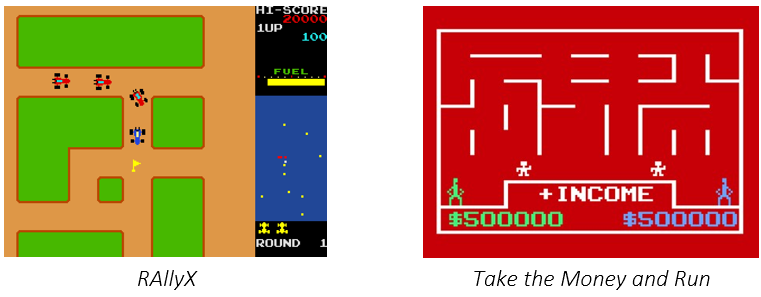
"Other games, such as Rally-X and Take the Money and Run, illustrate different ways a maze game can be expressed." (Non-functional)
(Other games, same concept)
(...)
"Although numerous differences may influence the impressions of the ordinary observer, 'slight differences between a protected work and an accused work will not preclude a finding of infringement' where the works are substantially similar in other respects. Exact reproduction or near identity is not required to establish infringement." (Average Consumer and Trade Dress / Overall Visual Appearance)
"In comparing the two works, the district court focused on certain differences in detail and apparently ignored (or at least failed to articulate) the more obvious similarities. The sine qua non of the ordinary observer test, however, is overall similarity, rather than minute differences between the two works. When analyzing two works to determine whether they are substantially similar, courts must be careful not to lose sight of the forest for the trees." (Trade Dress / Overall Visual Appearance)
"Several retailers and salespeople described the game by referring to PAC-MAN. Comments that K.C. Munchkin is 'Odyssey's PAC-MAN' or 'a PAC-MAN game' especially reflect that at least some lay observers view the games as similar." (Consumer Public and Distinctiveness) (Secondary Meaning)
Key Arguments and Legal Theories
Throughout the decision, the court cited relevant statutes and applied several well-established legal tests, drawing upon case law to properly resolve the dispute:
Copyright Law of the United States: Protects fixed, expressed elements, but not concepts or ideas (Reyher v. Children's Television Workshop, 533 F.2d 87, 90 (2d Cir.); 17 U.S.C. § 102 – Subject matter of copyright).
Ordinary Observer Test: If the ordinary observer considers the works aesthetically similar overall, minor differences will not preclude a finding of infringement (Peter Pan Fabrics, Inc. v. Martin Weiner Corp., 274 F.2d 487, 489 (2d Cir. 1960); Roth Greeting Cards v. United Card Co., 429 F.2d 1106, 1110 (9th Cir. 1970)).
Abstractions Test: When generic patterns render the work common or unoriginal, protection is limited (Nichols v. Universal Pictures Corp., 45 F.2d 119, 121 (2d Cir. 1930), cert. denied, 282 U.S. 902, 51 S. Ct. 216, 75 L. Ed. 795 (1931)).
Idea-Expression Merger Doctrine: When an idea and its expression are inseparable or indistinguishable, copyright will only protect against identical copying (Herbert Rosenthal Jewelry Corp. v. Kalpakian, 446 F.2d 738 (9th Cir. 1971)).
Scènes à Faire Doctrine: Indispensable or standard features in the treatment of a specific theme do not receive broad protection. They "refer to incidents, characters or settings which are as a practical matter indispensable, or at least standard, in the treatment of a given topic" (Alexander v. Haley, 460 F. Supp. 40, 45 (S.D.N.Y. 1978)).
Final Decision
Ultimately, the court concluded that despite minor differences, K.C. Munchkin! captured the "total concept and feel"—that is, the trade dress—of PAC-MAN, rendering it substantially similar.
In other words, although the lawsuit fundamentally centered on copyright law, the ruling also incorporated key trade dress considerations, such as priority of use, distinctiveness, non-functionality, and the likelihood of consumer confusion regarding overall visual appearance.
The conclusion was that the overall similarity between the games could mislead consumers into associating K.C. Munchkin! directly with PAC-MAN (Section 43(a) of the Lanham Act, 15 U.S.C. § 1125(a)).
Finally, the appellate court reversed the trial court's decision, ruling in favor of Atari:
"Based on an ocular comparison of the two works, we conclude that plaintiffs have shown a likelihood of success on the merits. Although not 'virtually identical' to PAC-MAN, K.C. Munchkin captures the 'total concept and feel' and is substantially similar to PAC-MAN. This case is a far cry from those where the defendant appropriated only the idea of the game, adopting its own unique form of expression, or where minor variations or differences were sufficient to avoid liability because the form of expression was inextricably tied to the game itself."
Trade Dress and Video Games
While trade dress typically refers to the distinctive visual appearance or packaging of a product, it can also extend to the overall combination of visual elements in a video game.
Beyond serving as a landmark milestone in video game history and copyright law—highlighting the importance of protecting original works and the need to distinguish between abstract concepts and their specific expressions—the dispute between PAC-MAN and K.C. Munchkin! incorporated requirements related to trade dress and unfair competition into its analysis. This paved an additional pathway for video game protection, particularly for titles whose overall visual appearance achieves distinctiveness, allowing them to be easily recognized by consumers even without seeing their literal trademarks.

Importance of the Decision
PAC-MAN v. K.C. Munchkin, frequently cited in discussions on video game intellectual property, established an important precedent for the industry because, beyond focusing primarily on copyright infringement, it also addresses key trade dress issues.
Trade dress protection helps prevent consumer confusion by safeguarding the set of distinctive visual elements that identify the brand or origin of a product or service.
In this regard, the case demonstrated that, in addition to copyright, the visual elements that form a game's distinctive overall visual appearance—serving a quasi-trademark function—can also enjoy the protection conferred by trade dress law.


Comments