The Impacts of Xbox/Microsoft's Ban on Unauthorized Third-Party Accessories
The video game industry is characterized by constant innovation, driven by the development of consoles and accessories that provide increasingly immersive gaming experiences.
In this dynamic scenario, intellectual property protection plays an essential role, with trademarks, industrial designs, and patents emerging as fundamental tools to guarantee exclusivity regarding the name, aesthetics, function, and technology of these products.
Trademarks—which ensure the identification of the origin of products and services—industrial designs—which protect the visual and ornamental elements of accessories—and patents—which protect technological and functional innovations—work together to safeguard a large portion of intellectual property in the video game sector. In other words, they play distinct yet complementary roles, promoting fair competition and encouraging continuous innovation.
In addition to establishing that protecting industrial property is a key way to foster the country's technological and economic development, the Brazilian Industrial Property Law (LPI – Law No. 9,279/96), through a recent amendment, specifically provided for the granting of registrations for electronic games:
Law No. 9,279, of May 14, 1996.
Regulates rights and obligations relating to industrial property.
Art. 2. The protection of rights relating to industrial property, considering its social interest and the technological and economic development of the Country, shall be effected by:
I – the granting of invention patents and utility model patents;
II – the granting of industrial design registrations;
III – the granting of trademark registrations;
IV – the repression of false geographical indications;
V – the repression of unfair competition; and
VI – the granting of registrations for electronic games. (Included by Law No. 14,852 of 2024)
However, a challenge arises when unauthorized accessories—those not manufactured by official developers or their authorized partners—flood the market. These products capture a significant portion of the sector's revenue while threatening not only intellectual property rights, but also device integrity and security.
In regions like Brazil, these accessories gain widespread popularity due to the high cost of official peripherals, which are unfriendly to consumers' wallets.
Along these lines, Xbox's decision to ban unauthorized third-party accessories for use on its consoles highlights the importance of these intellectual property protections, while raising questions about the measure's overall impact on the industry.
The measure aims not only to curb the proliferation of unauthorized accessories—which are frequently counterfeit products—but also to guarantee the quality of the gaming experience for consumers, ensuring that only products meeting the standards established by Xbox itself are compatible with its systems:

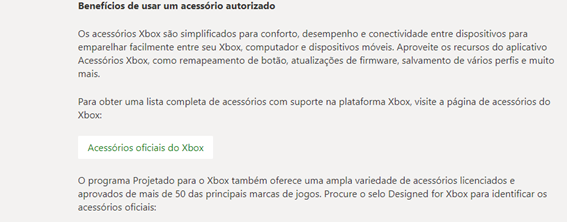
Available at: https://support.xbox.com/pt-BR/help/family-online-safety/enforcement/unauthorized-controller
"User reports show that Xbox gives a two-week timeframe before blocking the accessory or controller. Error code 0x82d60002 appears as soon as the product is connected. The text also suggests that the user return the product to the store or contact the manufacturer."
With this measure, in addition to protecting its own intellectual property, Xbox fosters the development of accessories by its authorized partners—companies with greater credibility among consumers. By following quality guidelines for peripheral development, authorized partners receive the "Designed for Xbox" badge:

Available at: https://www.xbox.com/en-US/designed-for-xbox
Moreover, this action aligns with the principles guiding intellectual property protection, encouraging the production of quality items and protecting not only the holder of these assets, but also the end user, who can rely on products that have passed the quality control of a company with a strong reputation in its market segment.
However, while this action aims to protect console integrity and ensure a quality gaming experience for players, it also raises a discussion from a consumer rights perspective, as consumers lose the ability to choose parts from other manufacturers that are compatible with the Xbox system based on price and availability.
Furthermore, when adding to this equation the principle of free enterprise, abuse of economic power, elimination of competition, and the debate surrounding so-called "replacement parts"—in cases where the developer ceases production of controllers compatible with legacy consoles—the discussion becomes even more complex. Let us examine what the law provides:
Federal Constitution of 1988
Art. 173. Except as provided for in this Constitution, direct state operation of an economic activity shall only be permitted when required by national security imperatives or relevant collective interest, as defined by law.
§ 4. The law shall repress any abuse of economic power aimed at market dominance, elimination of competition, and arbitrary increase of profits.
Law No. 12,529, of November 30, 2011.
Structures the Brazilian Competition Defense System; provides for the prevention and repression of violations against the economic order.
Art. 1. This Law structures the Brazilian Competition Defense System (SBDC) and provides for the prevention and repression of violations against the economic order, guided by the constitutional principles of freedom of initiative, free competition, the social function of property, consumer protection, and the repression of abuse of economic power.
Single Paragraph. Society as a whole is the beneficiary of the legal rights protected under this Law.
Art. 36. Acts in any form expressed that have as their object or may produce the following effects, even if not fully achieved, constitute a violation of the economic order, regardless of fault: […]
IV – abusively exercising a dominant position.
§ 3. The following practices, among others, insofar as they constitute a scenario provided for in the head section of this article and its subsections, characterize a violation of the economic order:
I – agreeing, combining, manipulating, or adjusting with a competitor, in any form:
a) the prices of goods or services offered individually;
b) the production or marketing of a restricted or limited quantity of goods or the provision of a restricted or limited number, volume, or frequency of services;
c) the division of parts or segments of an existing or potential market for goods or services through, among other means, the allocation of customers, suppliers, regions, or time periods;
d) prices, terms, advantages, or abstention in public bidding procedures; […]
XIX – abusively exercising or exploiting industrial property, intellectual property, technology, or trademark rights.
Consumer Defense Code
Art. 32. Manufacturers and importers must ensure the supply of components and replacement parts as long as the manufacture or import of the product has not ceased.
Ultimately, intellectual property protection—whether through trademarks, industrial designs, patents, or other forms of protection—is crucial to fostering sustainable and continuous innovation in the video game industry and ensuring the integrity of products available on the market. However, it also brings to the table an important discussion about the need to balance the interests of the industry and consumers.
Sources:https://www.theverge.com/2023/10/30/23938206/microsoft-xbox-controller-block-unauthorized-accessory-error-0x82d60002https://tecnoblog.net/noticias/microsoft-passa-a-bloquear-acessorios-piratas-no-xbox/#:~:text=Entre%20os%20produtos%20banidos%20est%C3%A3o,trapa%C3%A7a%2C%20como%20o%20Cronus%20Zen.


Comments